Companies Compliance Facilitation Scheme (CCFS-2026): Step-by-Step Guide to Clear Pending MCA/ROC Filings with 90% Late Fee Relief
Companies Compliance Facilitation Scheme (CCFS-2026)
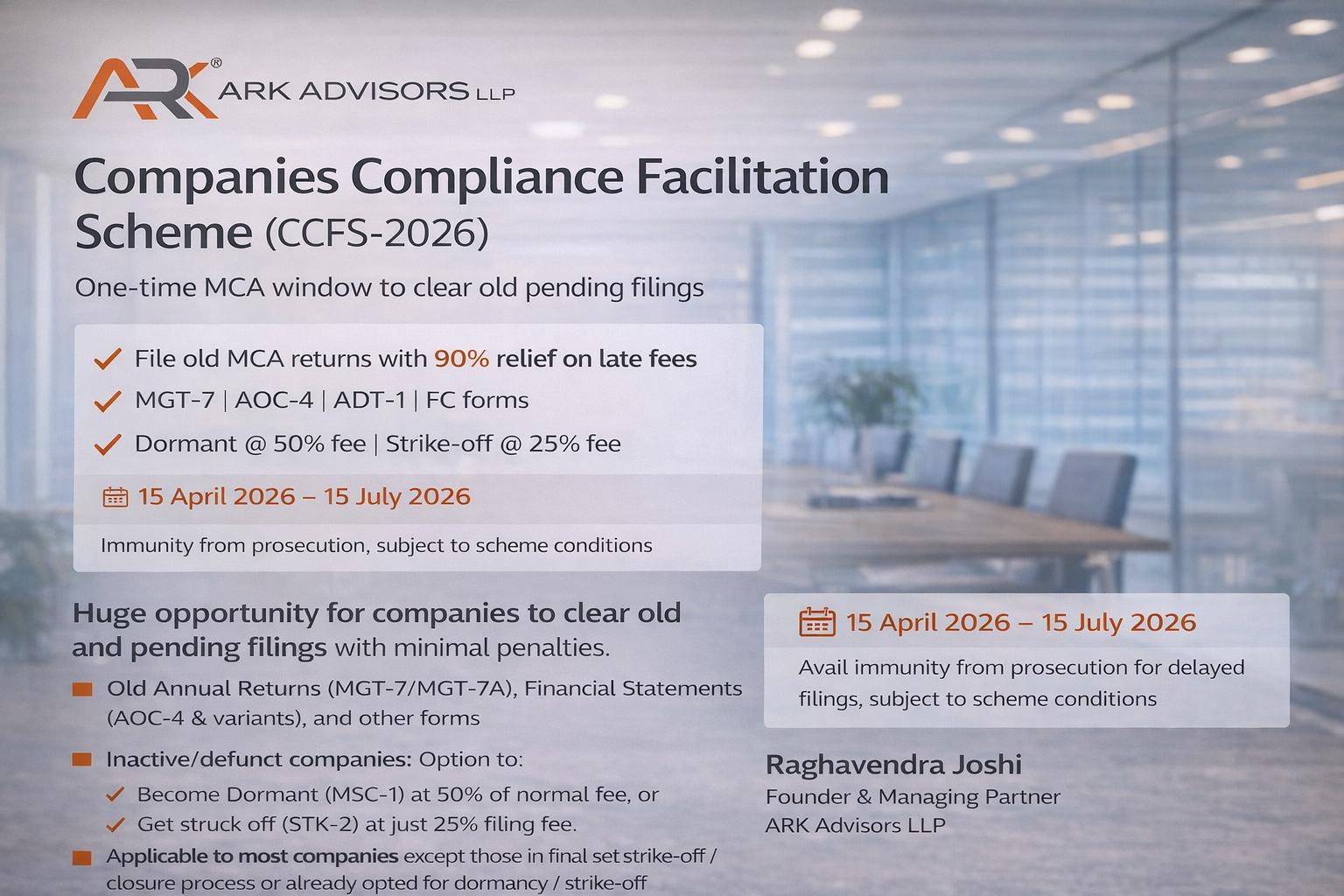
A one-time MCA window to clear old pending ROC filings with 90% relief on late fees
Many companies in India have old pending MCA filings such as Annual Returns and Financial Statements. Over time, late fees keep adding up year after year. In many cases, the late fees alone have gone into lakhs.
To address this long-pending issue, the Ministry of Corporate Affairs (MCA) has introduced a one-time compliance window called the Companies Compliance Facilitation Scheme – CCFS-2026.
This scheme gives companies a rare opportunity to clean up past non-compliances at a significantly reduced cost.
Scheme Period – Important Dates
The CCFS-2026 scheme is available only for a limited period:
Scheme start date: 15 April 2026
Scheme end date: 15 July 2026
Once this window closes, normal penalties and legal consequences under the Companies Act will apply.
Which MCA Forms Are Covered Under CCFS-2026?
• MGT-7 / MGT-7A (Annual Return)
• AOC-4 and related variants (Financial Statements)
• ADT-1 (Auditor Appointment)
• Certain Foreign Company (FC) forms, where applicable
These forms mainly relate to annual compliance that companies often miss over multiple years.
What is the main benefit? (Simple example)
The biggest benefit of CCFS-2026 is the massive reduction in late fees.
Example: If your late fee is ₹1,00,000, under CCFS-2026 you may pay only ₹10,000 as additional fee (plus normal filing fee).
What if the company is inactive?
If your company is not doing any business, you can consider:
• Dormant Status (MSC-1) at 50% of normal fee, or
• Strike-off (STK-2) at 25% of filing fee
Step-by-step: What should a company do now?
-
Check which years’ MCA filings are pending on the MCA portal
-
Decide: continue / dormant / strike-off
-
Gather financial statements + annual return data
-
File pending forms year-wise in proper sequence
-
Pay fees and keep SRN acknowledgements
-
Set a compliance calendar going forward
Final Note
CCFS-2026 is a rare opportunity to clean up old compliance issues at a minimal cost. Once this window closes, the cost and consequences will be much higher. If your company has pending MCA filings, this is the right time to act.
FAQs
Can I file only one pending year under CCFS-2026 and leave other years for later?
Technically, forms can be filed year-wise, but practically it is not advisable. Filing only one year while older years remain pending can create mismatches and further notices. It is best to plan complete cleanup of all pending years during the scheme window.